
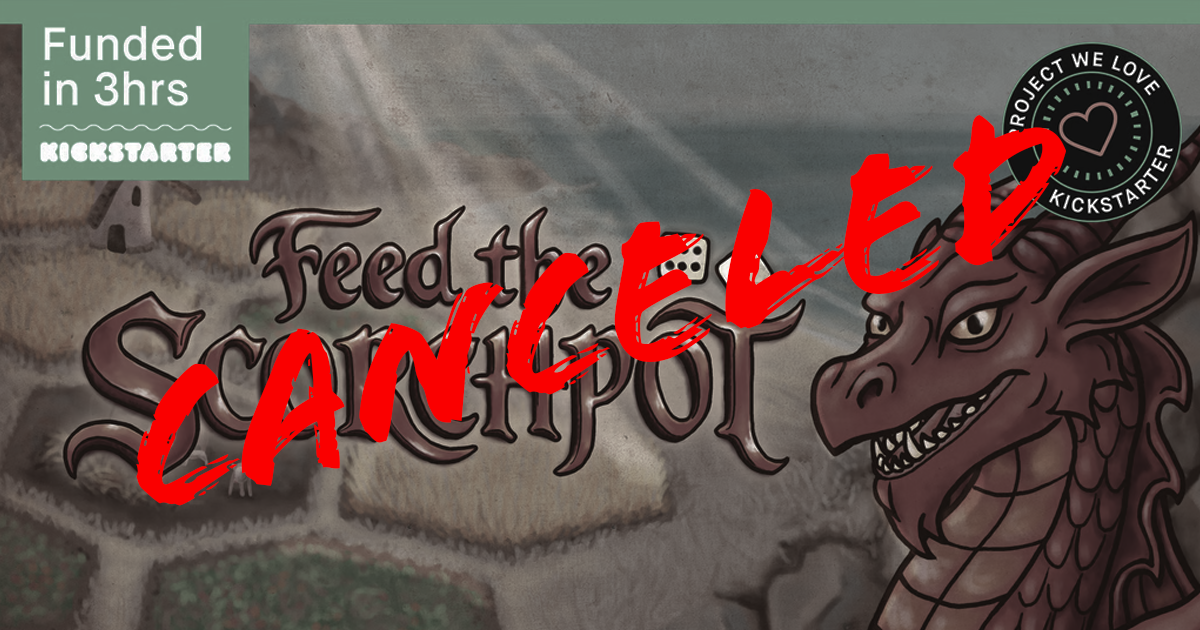
We cancelled a Kickstarter campaign that had already hit its goal.
Blasphemy, I know. Stick with me.
PUBLOG
The thing nobody tells you about
What a world we live in, huh? Where running a Kickstarter — something designed to fund your project — can end up costing you more than it gives back.
Crazy.
It's not always like this. But attention is brutal right now. Most of the time you either grind on content and social to drag an audience around with you, or you pay to put an audience in front of the campaign. We did the second one. We ran two successful campaigns for Feed the Scorchpot with no social following to lean on — just a strong Discord community (strong, as in, they’re awesome supporters — not a huge server). So we knew, going in, we'd have to buy the awareness before launch.
Talk is cheap
I couldn't count how many people told us "this looks like it'll do really well!" or "you'll smash your goal, no problem."
Heed my warning: ignore these comments.
Talk is cheap. "Looks like it should do well" means nothing for the preparation it really takes. Hours on custom art for the pages. More hours deciding rewards. More hours chasing suppliers for quotes. More hours building ad campaigns across networks.
It's a lot. And doing all of it doesn't mean you'll "smash it." We've backed over 125 Kickstarter projects — every one of which we thought deserved to be funded. Some didn't. We are one of the lucky few who get to say successfully funded.
But not without costs.

Our Meta costs over the ad period
The real number: A$11,721.22
The obvious cost is time — tweaking this, chasing that, fielding everyone's " Kickstarter hacks." The less obvious one is cash. We spent A$11,721.22 on marketing the first campaign. To the cent:
A$5,600 — Ad management (we hired someone to run ads for two months; there's only so much capacity we have)
A$4,397.44 — Meta Ads
A$1,723.78 — Reddit Ads, creator video + fee for sourcing physical fulfilment
That A$11,721 was the price of building an audience from zero (almost, shoutout to the Discord fam).
Where it went wrong
We treated the first Kickstarter as a "marketing beat". A moment to make noise, as much as a way to fund things along the way. We did that on purpose: we had to know we could still make the game if the campaign failed, so we refused to make it our make-or-break.
If we did it again: scrap that thinking entirely. There is too much work, time and money poured into a campaign for it to be a "beat." Treat a campaign LIKE A CAMPAIGN.
The other mistake was momentum. 30 days is a long time to campaign, and every single day is an opportunity — we didn't seize most of them. Despite that, with a A$10,000 goal we were sitting at A$17,500 by around day 20.
Not quite.

Why we canceled a funded campaign
We'd cleared the goal by a healthy margin. But there was an oversight… a big one.
We had physical reward tiers. And listening to enough people say "you'll smash it" had us believing we'd pull enough backers to cover our manufacturing minimums. We weren't even close. Our minimum was 100 pieces (not a lot) and we were struggling to get past 50 backers for those tiers.
If we'd closed the campaign out, real money would've gone toward inventory no-one ordered. Stock we'd have to store and figure out what to do with.
So we did the only responsible thing we could think of.
We cancelled a funded campaign.
We'd rather kill a "success" than get in over our heads on a logistical nightmare of dead stock and global shipping. (For the record: cancel a Kickstarter and nobody gets charged — backers keep their money, we keep our sanity.)
Round two: same campaign, A$0 spent
We paused for a week. Then Kickstarter reached out directly — they'd seen what happened, and encouraged us to go again while it was all still fresh.
So we tied the laces back up.
We relaunched a near-identical campaign — but we stripped the physical rewards, made it fully digital, tightened the offering, and lowered the goal to A$5,000 (because this time we did the calculations). We reached just shy of A$8,000 in 8 days.
We spent A$0 marketing it. Not really by choice, but because we’d spent everything we had on the first one. So we just ran it again, told everyone what had happened and why we were back, and hope we’d done enough to get people coming back.

What we'd tell you to do
A little wild from start to finish, but we got there. The takeaways that were worth the price:
Test multiple ad creatives. Find what performs well before you throw money at it.
Reddit was great for wishlists. Meta was great for Kickstarter follows. Pick the platform for the job you need done.
Don't set an arbitrary launch date. This is the big one. Gather your followers first, then launch.
Know your conversion math before you pick a day. Roughly 8–12% of your followers will convert. Work out how many followers you need to clear your lowest tier at that rate — and wait until you have them.

Stats from campaign #1

Stats from campaign #2
You get one shot at launching a campaign. We were successful, and we still could've done it better. Excellent learnings for next time.
Come ask us anything
If you want advice, we're always up for a chat. Join the Indieformer Discord and ask away — no paywalls or doors to get through to our experience.
Josh & Clem